


25
2025
-
08
Knowledge popularization! How to classify and determine the environmental protection level of sheet metal
Board is one of the commonly used materials in furniture products. In procurement activities, buyers attach great importance to the environmental protection level of board, which is also a high-frequency evaluation factor. Why do buyers attach great importance to the environmental protection level of sheet metal? How to classify the environmental protection level of different types of boards? What is the basis for division?
How to determine the environmental protection level of sheet metal?
What is the environmental protection level of furniture panels? The E-level standard originated in Germany and is a long-standing international definition of formaldehyde content in boards. It is a guiding specification for the formaldehyde emission of artificial boards and their products in the academic community. E0 level refers to the environmental protection level of the board, in addition to E1 level and ENF level, which can be used and labeled according to the latest standards issued in China.
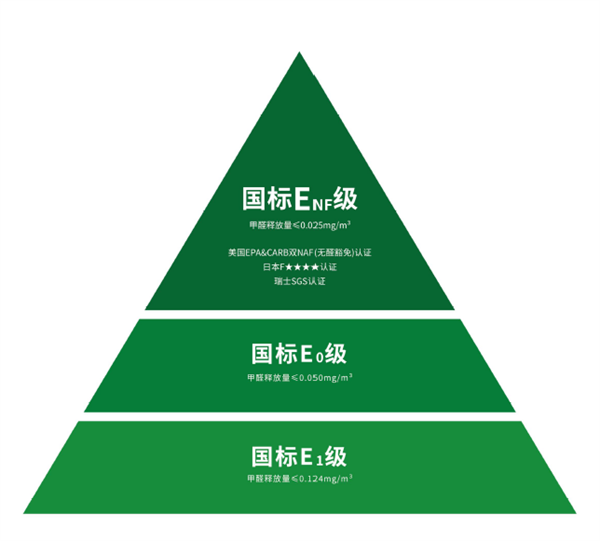
The main indicator of environmental protection for boards is the amount of formaldehyde released from the board, which is usually divided into three levels based on the size of the formaldehyde release in the board, "said Xiao Min, General Manager of Jiali Xinde Furniture Co., Ltd. The classification of environmental protection levels for boards is based on GB/T 39600-2021" Classification of Formaldehyde Release from Artificial Boards and Their Products ", which is divided into three levels: E1 level, E0 level, and ENF level. E1 level refers to formaldehyde emission ≤ 0.124mg/m ³; E0 level refers to formaldehyde emission ≤ 0.05mg/m ³; ENF refers to formaldehyde emission ≤ 0.025mg/m ³; These data are judged based on laboratory testing results.
At present, the most common environmental protection grades for sheet metal are E0 and E1, and there are also a small number of formaldehyde free sheets on the market, mainly for high-end customization. The specific standards vary by country. E0 level is an ideal environmental standard, followed by E1 level, which is a mandatory national standard requirement.
Zhang Ensong, director of the laboratory of Shenzhen Furniture Industry Association and Shenzhen Saide Testing Technology Co., Ltd., said that the formaldehyde emission levels of E1, E0, and ENF are strictly regulated step by step. That is to say, the formaldehyde emission level of E1 is higher than that of E0 and ENF; At the same time, the TVOC release of the board is the abbreviation for "Total Volatile Organic Compounds", which means total volatile organic compounds. )It can also be tested according to GB/T 29899-2013 "Test method for volatile organic compound release from artificial boards and their products - Small release chamber method", and according to the requirements of GB/T 35601-2017 "Green product evaluation of artificial boards and wooden floors" standard.
How to determine whether the environmental protection level of the board meets the standard?
How to determine whether the formaldehyde emission meets the standard in furniture procurement activities? What are the testing methods available?
To determine the environmental protection level of the board, the following methods can be referred to: first, check the inspection report. When purchasing furniture, the purchaser can check the board testing report to understand whether the formaldehyde emission meets relevant standards; The second is to smell the odor. Formaldehyde is a gas with a pungent odor. If the board has a pungent odor, it indicates that its formaldehyde release may be high; The third is to focus on brand selection. It is recommended that the purchaser choose a brand manufacturer with strict requirements for product quality control and environmental standards, as the risk of product failure is relatively low; The fourth is to consult professionals. If the purchaser is unsure about the environmental protection level of the board, they can consult professionals to understand the relevant standards and testing methods.
Gu Jiajia, Deputy Secretary General of the Zhejiang Furniture Industry Association, added that the purchaser can entrust a third-party testing agency to conduct tracking and testing, sampling and testing of raw materials, production processes, and finished products, comparing them with the indicators in the procurement requirements, and conducting acceptance based on the testing report.
Shuai Zhiyong, General Manager of Guangzhou Zhisheng QUAMA Furniture Co., Ltd., suggested that buyers should prioritize risk points and control the product production process. During the acceptance inspection, the purchaser can conduct spot checks and comparisons based on the environmental protection level requirements specified in the procurement documents. For example, for panel furniture, there are multiple color boards and specifications of panels used, and the procurement documents should clearly specify the environmental protection level of all panels. Furniture made of paint or other composite materials is difficult to detect because the painted furniture has already undergone deep processing. It is indeed difficult to reproduce the environmental protection level of the finished furniture. The purchaser can conduct indoor air quality inspection after the furniture enters the site to ensure that the formaldehyde emission meets the requirements and is environmentally friendly and healthy.
In recent years, there have been standards for indoor comprehensive formaldehyde emissions, and the emissions from each piece of furniture are low. When combined, exceeding a specific value can be harmful to the human body, especially when staying in spaces with excessive formaldehyde emissions for a long time. "Fan Dongxia suggests that buyers need to be aware that some suppliers may say" E0 is the highest standard and the best board "when describing the environmental protection level of the board, omitting the most critical standard system name and confusing concepts. Buyers need to be more vigilant.


Get a Free Quote
Welcome to contact us for the a quotation for your projects.

Hotline
OFFICE & MEDICAL CARE PROJECT:
HOTEL & ELDERLY CARE PROJECT:
Address
GUANGZHOU OFFICE ADDRESS:Room 101, Quama Park,Shibei Industrial Zone,Dashi Town,Panyu District,Guangzhou,P.R.China
FOSHAN PRODUCTION BASE ADDRESS:No.A60,Xing tang Road,Datang Town, Sanshui District,Foshan city ,China
-
WhatsApp
-
Tel
-
OFFICE & MEDICAL PROJECT
-
HOTEL & OLDERLY CARE PROJECT
